

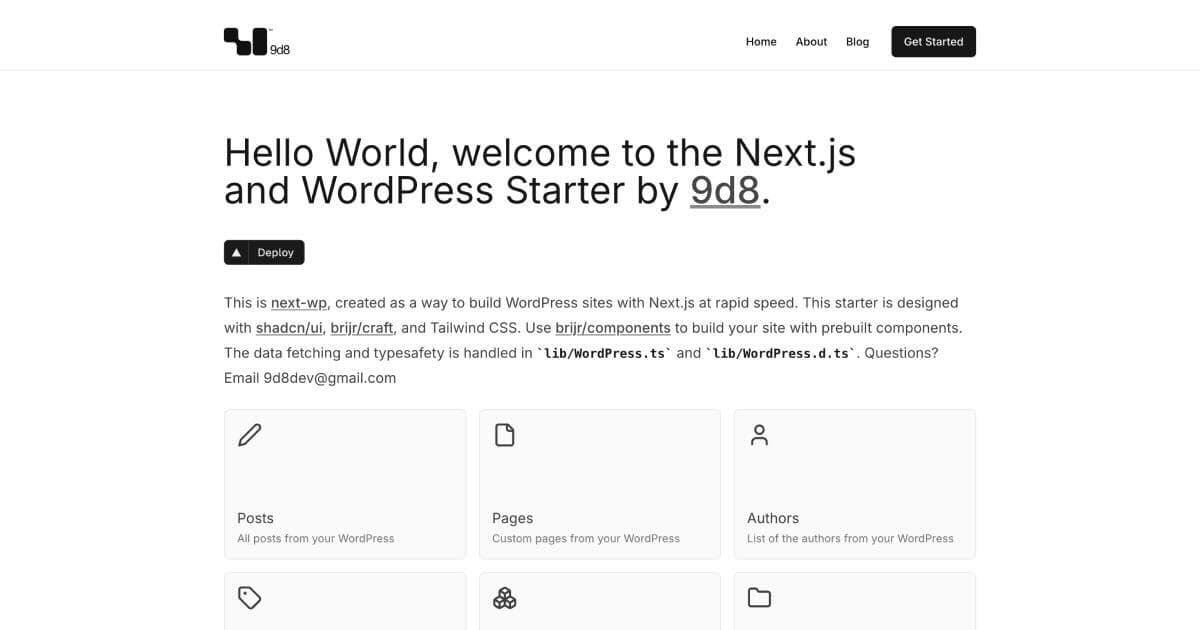
Next WP
A modern headless WordPress starter built with Next.js 16, React 19, and TypeScript.
Live Demo | Video Tutorial | Headless Theme (761)
Need a WooCommerce version? Try next-woo
Table of Contents
- Quick Start
- Prerequisites
- Environment Variables
- Features
- Project Structure
- Deployment
- Railway (Recommended)
- Vercel
- Local Development
- WordPress API Functions
- Cache Revalidation
- Customization
- Troubleshooting
- Testing
- Scripts
- Contributing
- License
- Credits
Quick Start
# Clone the repositorygit clone https://github.com/9d8dev/next-wp.gitcd next-wp
# Install dependenciespnpm install
# Set up environment variablescp .env.example .env.local# Edit .env.local with your WordPress URL and credentials
# Start development serverpnpm devYour site is now running at http://localhost:3000.
Prerequisites
- Node.js 18.17 or later
- pnpm 8.0 or later (recommended) or npm/yarn
- WordPress site with REST API enabled (default in WordPress 4.7+)
Environment Variables
Create a .env.local file in the root directory:
WORDPRESS_URL="https://your-wordpress-site.com" # Full WordPress URLWORDPRESS_HOSTNAME="your-wordpress-site.com" # Domain for image optimizationWORDPRESS_WEBHOOK_SECRET="your-secret-key-here" # Secret for cache revalidationFeatures
- Type-safe WordPress API - Full TypeScript support with comprehensive type definitions
- Server-side pagination - Efficient handling of large content libraries
- Automatic cache revalidation - WordPress plugin for instant updates
- Dynamic routes - Posts, pages, authors, categories, and tags
- Search & filtering - Real-time search with debouncing
- Dynamic sitemap - Auto-generated XML sitemap
- OG image generation - Dynamic social media cards
- Dark mode - Built-in theme switching
- shadcn/ui components - Beautiful, accessible UI components
- Responsive design - Mobile-first with Tailwind CSS v4
Project Structure
next-wp/├── __tests__/ # Vitest test suite│ ├── api/ # API route tests│ └── lib/ # Library tests├── app/ # Next.js App Router│ ├── api/│ │ ├── og/ # OG image generation│ │ └── revalidate/ # Cache revalidation webhook│ ├── pages/[slug]/ # Dynamic WordPress pages│ ├── posts/│ │ ├── [slug]/ # Individual post pages│ │ ├── authors/ # Author archive│ │ ├── categories/ # Category archive│ │ └── tags/ # Tag archive│ ├── layout.tsx # Root layout│ ├── page.tsx # Homepage│ └── sitemap.ts # Dynamic sitemap├── components/│ ├── posts/ # Post-related components│ │ ├── post-card.tsx # Post card component│ │ ├── filter.tsx # Filter controls│ │ └── search-input.tsx # Search component│ ├── nav/ # Navigation components│ ├── theme/ # Theme toggle│ └── ui/ # shadcn/ui components├── lib/│ ├── wordpress.ts # WordPress API functions│ └── wordpress.d.ts # TypeScript definitions├── plugin/ # WordPress revalidation plugin├── menu.config.ts # Navigation configuration├── site.config.ts # Site metadata└── vitest.config.ts # Test configurationDeployment
Railway (Recommended)
Railway deploys the complete stack with one click: MySQL + WordPress + Next.js.
What's IncludedThe Railway template uses a custom WordPress Docker image (ghcr.io/9d8dev/next-wp-wordpress) with:
- next-revalidate plugin - Pre-installed and auto-activated for cache revalidation
- nextjs-headless theme - Redirects WordPress frontend to your Next.js site
- WP-CLI - Automated WordPress setup
- MySQL 8.0 - Database with persistent volume
- Next.js - Your frontend application
┌─────────┐ ┌───────────┐ ┌─────────┐│ MySQL │────▶│ WordPress │◀────│ Next.js ││ DB │ │ (CMS) │ │(Frontend)│└─────────┘ └───────────┘ └─────────┘- Click the Deploy on Railway button above
- Wait for all 3 services to deploy (MySQL, WordPress, Next.js)
- Note the WordPress and Next.js public URLs from the Railway dashboard
1. Complete WordPress Installation
- Visit your WordPress URL (e.g.,
https://wordpress-xxx.up.railway.app) - Complete the installation wizard:
- Site Title
- Admin Username
- Admin Password
- Admin Email
- Click "Install WordPress"
2. Configure the Revalidation Plugin
The next-revalidate plugin is pre-installed and activated.
- Go to WordPress Admin → Settings → Next.js Revalidation
- Enter your Next.js URL (e.g.,
https://next-wp-xxx.up.railway.app) - Enter the Webhook Secret:
- In Railway, go to your Next.js service → Variables
- Copy the
WORDPRESS_WEBHOOK_SECRETvalue - Paste it in the plugin settings
- Click Save
3. Test the Setup
- Create a test post in WordPress and publish it
- Visit your Next.js site - the post should appear
- Edit the post in WordPress
- Refresh the Next.js site - changes should appear (revalidation working)
By default, the template deploys from the 9d8dev/next-wp repository. To customize:
- In Railway, click on the Next.js service
- Go to Settings → Source → Upstream Repo
- Click "Eject"
- Select your GitHub account/organization
- Click "Eject service"
Railway creates a copy of the repository in your GitHub. You can then:
- Clone the repo locally
- Make customizations (styling, components, pages)
- Push changes → Railway auto-deploys
Vercel
- Click the Deploy with Vercel button above
- Fill in environment variables:
WORDPRESS_URL- Your existing WordPress site URLWORDPRESS_HOSTNAME- WordPress domain (for images)WORDPRESS_WEBHOOK_SECRET- Generate a secure random string
- Deploy and wait for build to complete
- Install the revalidation plugin on your WordPress site
- Configure the plugin with your Vercel deployment URL
Local Development
# Install dependenciespnpm install
# Copy environment templatecp .env.example .env.local
# Configure your WordPress connection in .env.local# Then start the dev serverpnpm devRequired: Your WordPress site must have the REST API enabled (default since WP 4.7).
WordPress API Functions
All WordPress interactions are centralized in lib/wordpress.ts:
Posts
getRecentPosts(filters?) // Recent posts (max 100)getPostsPaginated(page, perPage, filters?) // Paginated posts with headersgetPostBySlug(slug) // Single post by slug (with _embed)getPostById(id) // Single post by IDgetAllPostSlugs() // All slugs (for static generation)getAllPostsForSitemap() // All slugs + modified datesTaxonomies
getAllCategories() // All categoriesgetCategoryById(id) // Category by IDgetCategoryBySlug(slug) // Category by sluggetAllTags() // All tagsgetTagById(id) // Tag by IDgetTagBySlug(slug) // Tag by sluggetPostsByCategory(id) // Posts in categorygetPostsByTag(id) // Posts with taggetTagsByPost(postId) // Tags on a postAuthors & Pages
getAllAuthors() // All authorsgetAuthorById(id) // Author by IDgetAuthorBySlug(slug) // Author by sluggetPostsByAuthor(id) // Posts by authorgetAllPages() // All pagesgetPageById(id) // Page by IDgetPageBySlug(slug) // Page by slugPaginated Queries
getPostsByCategoryPaginated(categoryId, page, perPage)getPostsByTagPaginated(tagId, page, perPage)getPostsByAuthorPaginated(authorId, page, perPage)Search
searchCategories(query) // Search categoriessearchTags(query) // Search tagssearchAuthors(query) // Search authorsExample Usage
import { getPostsPaginated } from "@/lib/wordpress";
const { data: posts, headers } = await getPostsPaginated(1, 9, { category: "news", search: "nextjs"});
console.log(`Found ${headers.total} posts across ${headers.totalPages} pages`);Cache Revalidation
The starter uses Next.js cache tags for efficient revalidation:
- Install the plugin - Download next-revalidate.zip and upload to WordPress
- Configure - Go to Settings > Next.js Revalidation
- Set URL - Enter your Next.js site URL
- Set secret - Use the same
WORDPRESS_WEBHOOK_SECRETvalue
When content changes in WordPress, only affected pages are revalidated.
Note: If using the Railway template, the plugin is pre-installed automatically.
Customization
Site Configuration
Edit site.config.ts for site metadata:
export const siteConfig = { site_name: "Your Site", site_domain: "yourdomain.com", site_description: "Your site description"};Navigation
Edit menu.config.ts for navigation links:
export const mainMenu = { home: "/", blog: "/posts", // Add more links...};
export const contentMenu = { categories: "/posts/categories", tags: "/posts/tags", authors: "/posts/authors",};Theming
This project uses shadcn/ui with Tailwind CSS. Customize colors in your CSS or update the shadcn theme.
Troubleshooting
REST API not accessible
- Ensure your WordPress site is publicly accessible
- Check that permalinks are set (Settings > Permalinks)
- Verify REST API at
your-site.com/wp-json/wp/v2/posts
Images not loading
- Add your WordPress domain to
WORDPRESS_HOSTNAME - Check
next.config.tshas the correctremotePatterns
Revalidation not working
- Verify
WORDPRESS_WEBHOOK_SECRETmatches in both WordPress and Next.js - Check the plugin is activated in WordPress
- Test the webhook endpoint at
/api/revalidate
CORS errors
- Install a CORS plugin on WordPress, or
- Configure your server to allow requests from your Next.js domain
Testing
The project uses Vitest for unit testing.
pnpm test # Run all testspnpm test:watch # Run in watch modeTests cover the core modules:
| Module | What's tested |
|---|---|
lib/utils | cn() class merging with Tailwind deduplication |
lib/metadata | stripHtml, truncateHtml, OG/Twitter metadata generation |
lib/wordpress | API fetch layer, pagination, error handling, graceful fallbacks |
api/revalidate | Webhook secret validation, content type routing, cache revalidation |
Scripts
pnpm dev # Start development serverpnpm build # Build for productionpnpm start # Start production serverpnpm lint # Run ESLintpnpm test # Run testsContributing
Contributions are welcome! Please:
- Fork the repository
- Create a feature branch (
git checkout -b feature/amazing-feature) - Commit your changes (
git commit -m 'Add amazing feature') - Push to the branch (
git push origin feature/amazing-feature) - Open a Pull Request
License
MIT License - see LICENSE for details.
Credits
Built with Next.js, Tailwind CSS, shadcn/ui, and brijr/craft.
Created by Bridger Tower and Cameron Youngblood at 9d8.
%20and%20the%20hostname%20for%20Image%20rendering%20in%20Next.js%20(e.g.%20wp.example.com)&from=templates&project-name=Next.js%20Starter%20for%20WordPress%20Headless%20CMS&repository-name=nextjs-wordpress-headless-cms&repository-url=https%3A%2F%2Fgithub.com%2F9d8dev%2Fnext-wp&skippable-integrations=1)